Spacecraft Voyager 1 reaches distance of one light-day from Earth
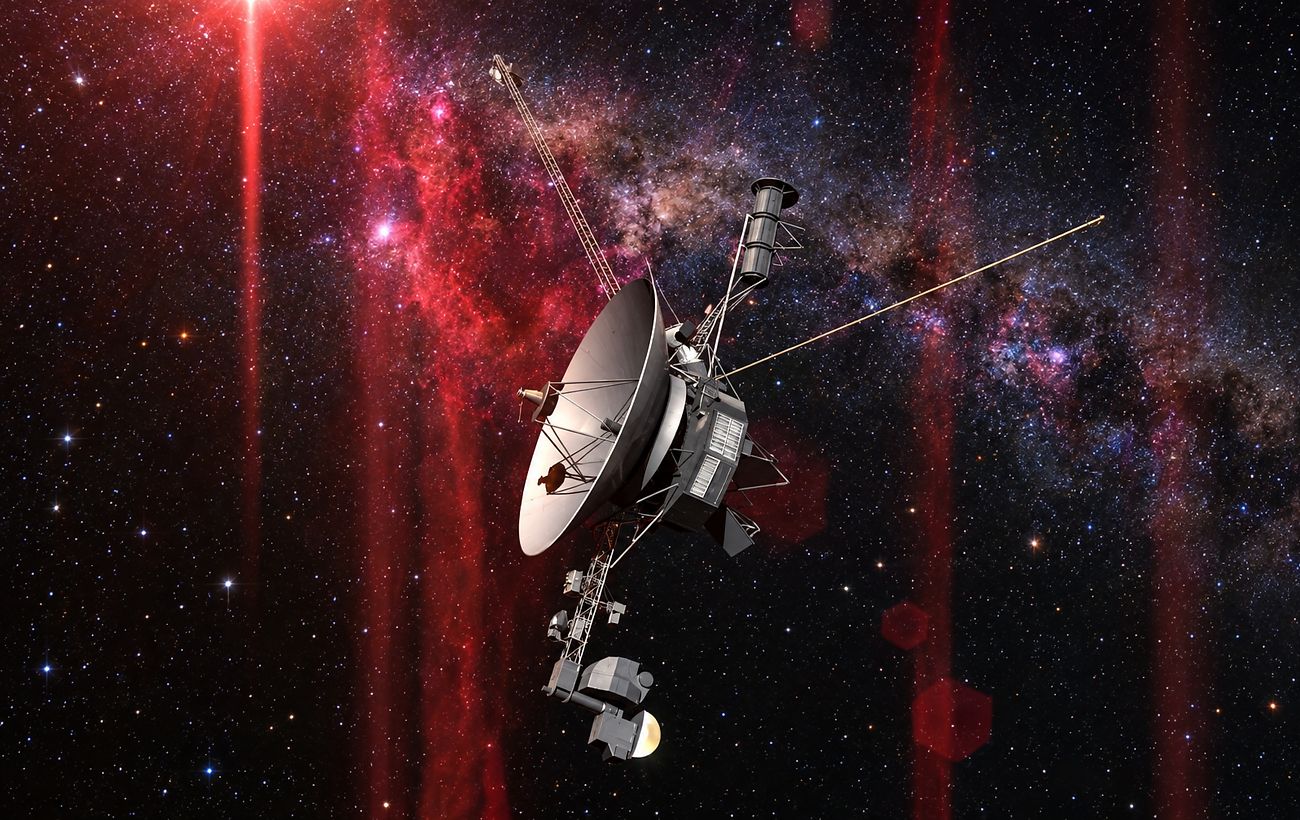
The American interplanetary probe Voyager 1 has set a historic record by moving away from Earth to a distance where radio signals take 24 hours to arrive.
 💡Tech
Photo: RBC-Ukraine
Key points
- Voyager 1 is now one light-day away from Earth
- The distance to the spacecraft exceeds 25 billion kilometers
- The speed difference between probes is caused by different flight paths
- Both spacecraft have a chance to continue operations into the 2030s
The legendary research probe Voyager 1, launched by the National Aeronautics and Space Administration last century, has reached a new incredible milestone. From now on, the distance between Earth and the spacecraft exceeds 25 billion kilometers, and a radio signal takes exactly one full day to reach it. To mark this occasion, the American space agency plans to invite astronomy enthusiasts to celebrate by transmitting special signals in Morse code.
Why the twin spacecraft move at different speeds
Interestingly, both spacecraft — Voyager 1 and Voyager 2 — went into space in 1977 with an interval of only two weeks. While the second probe launched first, its counterpart eventually managed to overtake it due to a different flight trajectory. NASA engineers deliberately directed the first spacecraft along a faster route, while the second was tasked with studying four giant planets in detail thanks to a rare planetary alignment.
Through complex gravitational maneuvers near Jupiter, Saturn, and other planets, the probes received extra acceleration acting like a cosmic slingshot. However, a detailed study of the Neptune system and its moon Triton forced Voyager 2 to significantly alter its course and lose some speed. Currently, the first spacecraft covers about 3.5 astronomical units annually, outpacing its cosmic companion along the way.
Future prospects and equipment status
Despite their advanced age and the gradual depletion of nuclear power sources, both unique interstellar spacecraft continue to transmit data. Engineers at the Jet Propulsion Laboratory have had to take measures to conserve energy, specifically by shutting down secondary instruments. Through optimization of management processes, scientists hope to maintain the probes' operability throughout the coming decade.
Source RBC-Ukraine — rbc.ua/ukr/news/voyager-1-vidletiv-svitloviy-den-vid-zemli-17950032… ↗
Read next
 ⚽Sport
Denys Berinchyk defeats Bovar Khanakov in Kyiv
Former world champion Denys Berinchyk made a successful return to the ring, defeating Bovar Khanakov at the 'Battle of Styles' tournament.
 🚨Events
Ukrainian citizen found dead in snowy Romanian mountains after illegal border crossing
Romanian rescuers found the body of a Ukrainian citizen and saved two of his companions in the Maramureș mountains after an illegal border crossing.
 ⚽Sport
Ukrainian boxer Sofiia Turbinina wins bronze medal at U23 European Championship in Croatia
The athlete successfully reached the semifinals of the continental championship in the under-48 kg weight category, where she lost to her Polish opponent.
 🇺🇦Ukraine
Finland plans to recover over 25 billion euros from Russia and Gazprom
Finnish authorities are taking steps to enforce international arbitration rulings against Russian entities to recover significant damages.
 💼Economy
Labor Shortage in Ukraine: Why High Salaries Do Not Solve the Specialist Gap
The Ukrainian labor market faces an acute shortage of blue-collar and technical professionals, where even salaries exceeding 60,000 hryvnias fail to attract enough candid…
 🏙️City
New Pentagon Restrictions: How US-Canada Relations Impact the Global Context
US Defense Secretary Pete Hegseth signed a classified directive limiting military cooperation with Canada, sparking unexpected diplomatic friction.